

A furnace almost never dies without warning. It grumbles at startup, runs in odd bursts, or quietly pads your gas bill for a few months first. The skill worth having isn't fixing it yourself — it's knowing which symptoms can wait, which deserve a service call this week, and which mean shut the system off tonight.
Here are the seven most common warning signs, sorted into three buckets — watch it, call soon, and shut it down now — along with what each fix typically costs in 2026. You don't need tools for any of this. Your eyes, your ears, and last winter's utility bill will do.
Two of the seven involve combustion safety, and they outrank everything else no matter how mild they look. Here's the full list, from least to most urgent:
If your gas usage is up 15 to 25 percent over the same month last year — compare therms, not dollars, since rates move — your furnace is working harder to deliver the same heat. The usual suspects are a clogged filter, dirty burners, or a blower motor on its way out. Start with the filter; it's a $10 to $40 fix you can do yourself in five minutes.
Uneven heat — toasty living room, icy back bedroom — usually points at ductwork or a weakening blower rather than the furnace itself. Typical costs when a pro gets involved:
These can ride for a few weeks while you schedule service. Don't let them ride all season — an overworked blower or an overheating heat exchanger tends to take other parts down with it.
Short cycling means the furnace fires, runs a few minutes, shuts off, and starts again — sometimes dozens of times a day. The common causes are a dirty flame sensor, a clogged filter tripping the high-limit switch, or a misreading thermostat. It wastes fuel and beats up the ignitor with every restart.
Noises are more specific than people think. A boom or bang at startup is usually delayed ignition — gas pooling in the burner box before it lights, which stresses the heat exchanger every single time. Screeching means blower bearings or a worn belt; rhythmic thumping is often an unbalanced blower wheel.
And if you're hitting the reset button or flipping the furnace breaker more than about once a season, stop resetting and get it diagnosed — something upstream is failing, usually a control board, pressure switch, or overheating motor. Anything involving the gas valve, ignition timing, or line-voltage wiring is a job for a licensed pro like Acme HVAC; those failure modes aren't forgiving of guesswork. Typical repair costs:
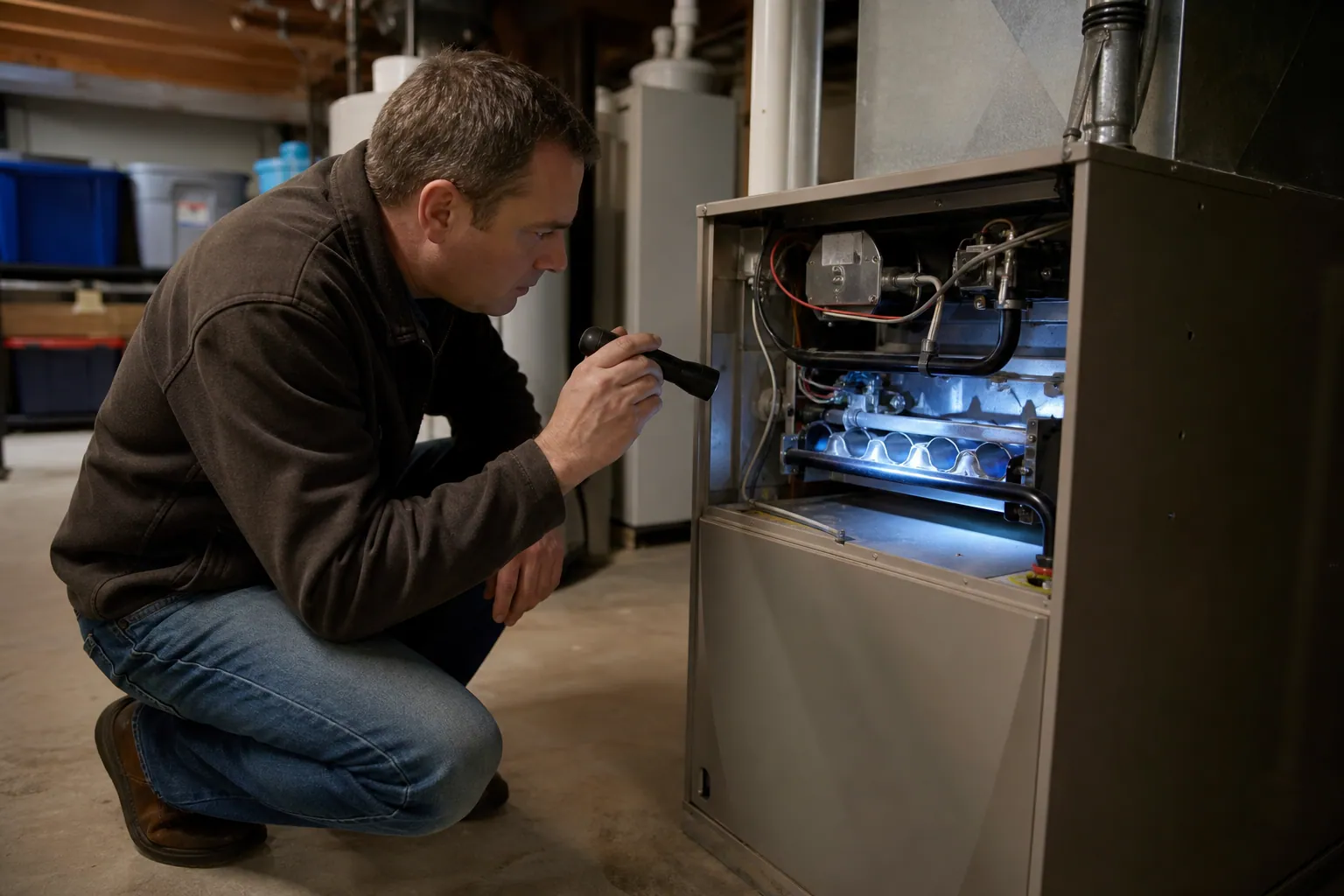
A healthy natural-gas flame burns steady and blue, with at most a small yellow tip. A flame that's mostly yellow or orange, or that flickers and lifts off the burner, means incomplete combustion — and incomplete combustion produces carbon monoxide. Soot streaks on the furnace cabinet or around your registers tell the same story.
If a CO alarm sounds, treat it as the emergency it is: get everyone outside, call 911 or your gas utility from the driveway, and don't go back in until it's cleared. If you spot a yellow flame or soot without an alarm, switch the furnace off at the service switch, keep your CO detectors running, and book an inspection for the next day — not next month.
The fix ranges widely. Dirty burners run $100 to $300 to clean and adjust. A cracked heat exchanger — the worst-case cause — costs $1,500 to $3,500 to replace, and on a furnace past 15 years that money is usually better put toward a new unit, which runs $4,500 to $9,500 installed in 2026.
A useful rule of thumb: multiply the furnace's age by the repair quote. If the result tops $5,000 — say, a $600 repair on a 12-year-old unit — replacement usually wins, especially since today's 96 percent AFUE furnaces burn noticeably less fuel than the 80 percent units common in older homes.
Two cheap habits prevent most of this list: swap the filter every one to three months, and book an annual inspection ($100–$200) each fall. Most of these seven signs show up on a technician's checklist a full season before they show up in your living room.