


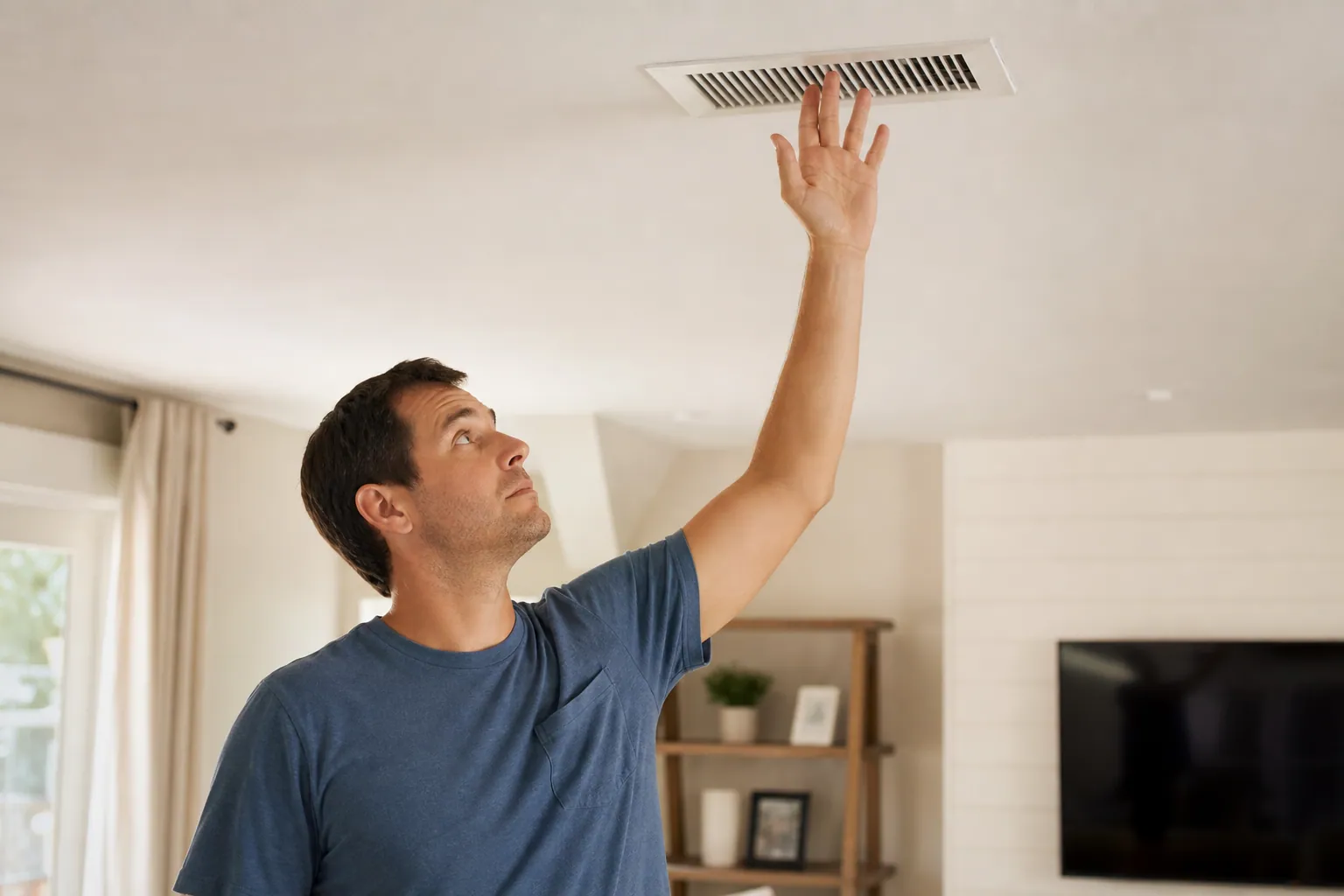
There's a specific kind of July frustration: the outdoor unit is humming, the vents are blowing, and the thermostat still reads 79 and climbing. The good news is that "running but not cooling" almost always traces back to one of seven causes — and the first several are things you can check yourself in under an hour, for free.
This checklist is ordered on purpose, from free two-minute checks to repairs that need a licensed tech. Work top to bottom and stop when the cold air comes back. Skipping ahead usually means paying someone to diagnose a problem a $15 filter would have fixed.
Confirm the mode is set to Cool — not Heat or Off — and the setpoint is at least a few degrees below the current room temperature. Then look at the fan setting: On runs the blower nonstop, so the vents push room-temperature air even when the system isn't actually cooling. Set it to Auto instead.
If the screen is blank or unresponsive, swap the batteries. And if anyone else in the house has app access to a smart thermostat, make sure a schedule or vacation hold isn't quietly overriding you. Safe DIY, and it costs nothing.
A filter choked with dust strangles airflow across the indoor coil, so the system runs long and cools weakly — and can eventually freeze solid (more on that below). Pull the filter and hold it up to a light. If you can't see light through it, replace it.
A standard 1-inch filter costs $10–$25 in 2026 and should be changed every 1–3 months during cooling season; thicker 4-inch media filters run $40–$60 and last 6–12 months. Safe DIY, and the single most common fix on this list.
Central AC typically uses two breakers: one for the indoor blower and a larger one (usually 30–60 amps) for the outdoor unit. If only the outdoor breaker trips, the blower keeps pushing warm air through the vents — which perfectly mimics "running but not cooling."
Open the panel and look for a handle sitting between On and Off. Flip it fully off, then back on. Resetting once is safe DIY; if it trips again, stop. Repeat trips point to a failing compressor, capacitor, or wiring fault, and forcing the breaker can turn a $300 repair into a dead compressor.
Weak airflow plus water pooling around the indoor unit — or frost on the copper line at the outdoor unit — means the evaporator coil has iced over. An iced coil can't absorb heat, so the AC runs constantly and cools almost nothing.
Turn the thermostat to Off with the fan set to On and let the ice melt; expect 2 to 12 hours, with towels ready around the air handler. Thawing is safe DIY, but ice is a symptom, not the disease. If a fresh filter and fully open vents don't keep it from coming back, the underlying cause is usually low refrigerant — which is pro territory.
The outdoor unit's whole job is dumping your house's heat, and it can't do that through a mat of cottonwood fluff, grass clippings, and dryer lint. A dirty condenser makes the system run hot, cool poorly, and burn extra electricity doing it.
Flip the outdoor disconnect off, then rinse the fins gently with a garden hose — never a pressure washer, which folds the fins flat. Keep about 2 feet of clearance around the unit. The rinse is free DIY; a professional deep clean with coil cleaner runs $100–$400 in 2026 and is often bundled into a $90–$200 seasonal tune-up.
If the outdoor fan hums but won't spin, or the compressor clicks and gives up, the run capacitor is the usual suspect — it's the part that kicks the motors into motion, and summer heat kills them regularly. The part itself is cheap, but capacitors hold a dangerous electrical charge even with the power off, so this one belongs to a technician. Professional replacement typically runs $150–$400.
Low refrigerant is the other big one, and it always means a leak — refrigerant doesn't get "used up." EPA rules require certification to handle it, and 2026 prices reflect the R-410A phase-down: figure $150–$500 for leak detection, $300–$800 for a recharge, and $500–$1,500+ to actually repair the leak (a leaking evaporator coil can hit $1,500–$3,500 to replace). A licensed contractor like Acme HVAC can pressure-test the system and tell you straight whether repair or replacement makes financial sense — on a 15-year-old unit, putting $1,000 into refrigerant often doesn't.
Run the checklist in this order and stop as soon as cold air returns:
Most no-cool calls end at the filter or the condenser. If you get through the whole list and the house is still warm, the problem is electrical or refrigerant-side — and diagnosing those takes gauges, a multimeter, and a license.